
Back to news
9th November 2026
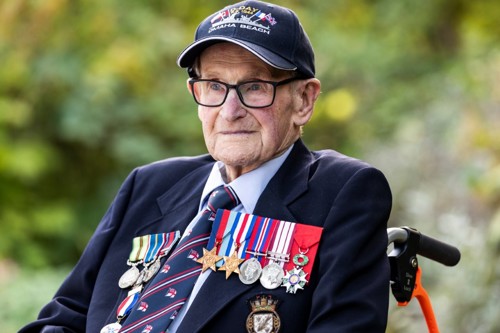
One of Scotland's last surviving D-Day veterans, who helped clear German minefields off Omaha Beach during the Normandy landings, has died aged 100.
Charlie Horne, originally from Prestonpans in East Lothian, was just 18 when he found himself under enemy fire aboard a small wooden minesweeper on June 6, 1944. Surrounded by sinking vessels, he witnessed scenes of devastation that would remain with him for the rest of his life.
Charlie survived the war and returned home to marry his sweetheart Jenny, raise three daughters and spend almost half a century working at sea. It was a life he never took for granted, knowing that thousands of young men who went to war had been denied the same opportunity.
He died on November 3 at Erskine Veterans Charity's Edinburgh Home, where he had been living since the summer.
His death comes just days before Remembrance Sunday. In recent reflections on his wartime experiences, Charlie spoke of his determination that the young men who never returned should not be forgotten.
Charlie said: "I will never forget what I saw. I don't think you could live through something like that and ever really leave it behind, no matter how many years pass.
"I was only 18 and there were ships being blown apart, men in the water and shells coming towards us from the shore. There were mines underneath us and you knew that one explosion in the wrong place could be the end of you and everyone around you.
"You were frightened, of course you were, but there wasn't time to sit and think about it. We had a job to do, the men beside you were relying on you, and you were relying on them, so you carried on.
"I've had another 82 years. I came home, fell in love, got married, had children and watched my family grow – thousands of young men never had the opportunity to experience any of those things, and that is tragic.
"I will remember them for as long as I am here, and I hope the generations who come after us will remember them too."
Born into generations of fishermen in Prestonpans, Charlie first went to sea aged just 14. When he was called up in 1943, he joined the Royal Naval Patrol Service, serving as a Stoker First Class aboard the minesweeper MMS 291.
Throughout the landings, Charlie kept a handwritten diary, recording what he witnessed whenever the danger and demands of his duties allowed. His entries provide a remarkable first-hand account of the events unfolding around him.
As the invasion began, bombs, shells and flares lit up the sky while Charlie's vessel swept to within half a mile of the French coast. German shore batteries fired towards the ships as the minesweepers continued their work, knowing the Allied vessels following behind depended on the channels being cleared.
In his diary that day, Charlie recorded seeing "lots of wreckage" and dead servicemen in the water, while bullets fired from the shore landed within around 50 feet from his vessel. He wrote that the horizon "could hardly be seen for landing craft", as his crew exploded eight mines before finally dropping anchor for a few hours' sleep, their first since leaving Plymouth three days earlier.
The danger did not end when the first Allied troops made it ashore. The minesweepers continued working off Normandy as German aircraft attacked at night.
On June 18, Charlie was just 100 yards away when another minesweeper, MMS 229, struck a mine. He recorded the moment in his diary, writing that the explosion "blew her bows clean off". The vessel remained afloat for several minutes before sinking, while Charlie and his shipmates launched their small boat to help rescue survivors.
By this stage, the scale of destruction had become almost impossible to comprehend. Charlie described the sea as "literally strewn with wrecked craft" and eventually wrote that he was giving up trying to count the ships which had been lost.
Despite the dangers, Charlie would later recall the friendships and sense of duty that helped him and his fellow servicemen through.
He said: "There was tremendous camaraderie between us and that is something I remember just as strongly as the frightening moments. We weren't thinking about being brave or being heroes, we were young men who had been given a job to do and who wanted to make sure the people around us got home safely."
Charlie was demobilised in March 1947 and returned to the fishing career that had been interrupted by the war.
During leave from the Navy the previous year, he had met Jenny Thayne at a dance. The couple married in 1949 and went on to have three daughters sharing 60 years of marriage before Jenny died in 2009.
His service during the Normandy landings was later recognised with the Légion d'honneur, France's highest order of merit.
In the summer of 2026, Charlie moved into Erskine's Edinburgh Home, where he enjoyed the companionship of fellow veterans and the care of staff.
Wing Commander Ian Cumming MBE, Chief Executive of Erskine Veterans Charity, said: "We are deeply saddened by Charlie's passing, and our thoughts are with his family, friends and everyone who knew and loved him.
"His passing is particularly poignant as we approach Remembrance. We are losing the last of a generation who experienced the Second World War firsthand, and with each passing, another irreplaceable connection to that period of our history is lost.
"It was a privilege to care for Charlie in the final months of his life. He will be remembered with great affection by everyone at Erskine, not simply for his remarkable wartime service, but for the man he was.”
For Charlie, Remembrance was always about the people whose lives were lost, rather than simply the events of the war itself.
He said: "When I think about the war now, it is the people I remember most. There are faces and moments which have stayed with me all my life, and that is why Remembrance has always been so personal to me.
"I hope people never see it as simply another date in the calendar or something that belongs to history. Behind every name on a memorial was a person with a family, ambitions and a life they wanted to come home to."
Charlie also spoke of the responsibility future generations would have to preserve the memories of those who served.
"There aren't many of my generation left who can say we were there, which is why I think it is more important than ever that we tell these stories while we still can.
"We don't tell them because we want people to think of us as heroes, but because we want people to understand what happened and what was lost.
"I will never forget the men who didn't come home. All I ask is that, when we are no longer here to tell you ourselves, you don't forget them either."


Inverness Military Wives Choir to sing for Scotland's leading veterans charity's EVAC North Veterans

The Princess Louise Scottish Hospital for Limbless Sailors and Soldiers

The Princess Louise Scottish Hospital for Limbless Sailors and Soldiers


