
Back to news
26th March 2024
In 1944 two Veterans for whom Erskine had the honour of caring for, took part in one of the most courageous and audacious escape attempts of the Second World War.
The Great Escape has been immortalised in books and film, yet the real story is even more remarkable. We look back in time to the events that made history and Hollywood.
The Great Escape was a mass escape from Stalag Luft III prison on the night of 24 March 1944. Planned by Allied prisoners of war over many months, it saw 76 men break free from what was considered one of Germany's most secure prisoner-of-war camps. Although only three men ultimately reached safety, the operation has become one of the most famous acts of resistance carried out by prisoners during the Second World War.
Among them were RAF servicemen Alex Lees and Jack Harrison. The part they played in the attempt by Allied prisoners-of-war to escape their captors is a story of courage and bravery.
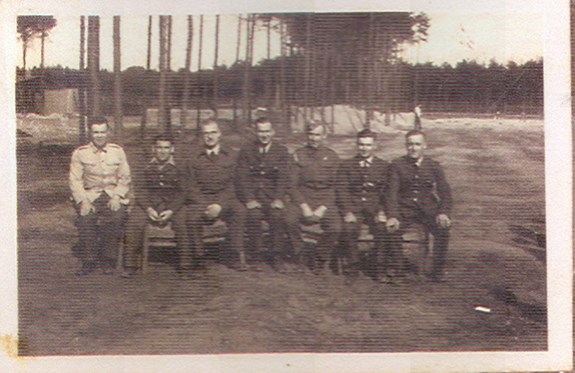
Alex (pictured third from the right) was captured by the Germans in 1941 and held in several POW camps before Stalag Luft III.
Jack (pictured far right) was an officer on his first mission.
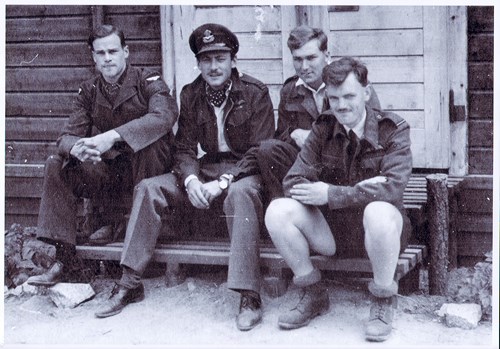
He was transferred to Stalag Luft III after being captured when his plane was brought down by the Germans from the ground after his compass, which had not been calibrated properly, led Jack and his crew 12 miles off course.
At one point, both thought they would not survive the night of the escape, let alone meet one another decades later after becoming residents at Erskine.
Stalag Luft III was built in the German province of Lower Silesia near the town of Sagan in Poland.
The camp, operated by the German Luftwaffe, opened in 1942 and was built specifically to house captured Allied air force officers. Unlike many other prisoner-of-war camps, it had been carefully designed to make escape almost impossible.
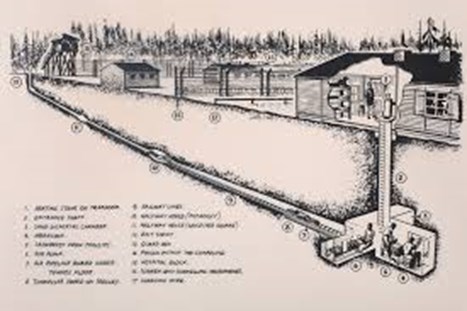
The barrack huts were raised above the ground, making it more difficult to begin tunnels unnoticed. The sandy soil beneath the camp was deliberately chosen because it was unstable to dig through and its pale colour made excavated earth easier for guards to spot. German engineers also installed sensitive listening devices around the perimeter to detect underground activity, while multiple barbed-wire fences, guard towers and constant patrols provided further protection.
Within the confines of this POW camp, surrounded by pine trees, the resolve to outwit the Germans was organised through a central Escape Committee led by Squadron Leader Roger Bushell, known as “Big X”.
Allied servicemen believed it was their duty to continue resisting the enemy even while in captivity. Every escape attempt forced Germany to divert valuable soldiers, police officers and resources away from the front line in order to hunt down escaped prisoners. The larger the escape, the greater the disruption to the German war effort.
Bushell set in train an elaborate plan to dig three tunnels, nicknamed 'Tom', 'Dick' and 'Harry' and to provide the escapees with civilian clothes and money, rations, briefcases and ID cards that would be vital should they make it out of the camp.
To give hundreds of prisoners a realistic chance of reaching neutral territory or returning to Britain, every detail had to be planned in secret. False identity papers had to be produced, civilian clothing made, German passes forged, and maps copied. Money, food, railway timetables and compasses all had to be gathered or manufactured inside the camp.
The scale of the operation required constant coordination between hundreds of prisoners working in complete secrecy. Every man had to refer to the tunnels by name. Bushell even threatened to court-martial anyone who even uttered the word "tunnel".
Each tunnel was an extraordinary engineering project. Prisoners installed wooden reinforcements to prevent collapse, ventilation systems to allow air to circulate and even electrical lighting powered by stolen wiring. There was also a trolley system to move sand along the tunnels.
Disposing of the sandy soil was one of the greatest logistical challenges. Prisoners devised ingenious methods, including specially adapted clothing that allowed them to distribute sand around the camp during daily routines. These men became known as “penguins” because of the way they waddled while dispersing earth beneath their trousers.
Alex was tasked with looking after a garden outside his hut. In a 2007 interview, he recalled that the Germans knew tunnels had been excavated at other camps, so the prisoners had to be very careful in disposing of the sand. It was transported from the digging site to the garden in Red Cross boxes. Being in charge of the garden afforded Alex the opportunity to dig a trench and disguise the sand by scattering it in the bottom and planting radishes, cress and tomatoes. The German guards would sometimes admire his efforts, little suspecting that his vegetables were an elaborate way to disguise what was going on nearby.
A sign of the prisoners' remarkable ingenuity in keeping things hidden from the German guards was that among the items later found to have gone missing were 4,000 bed boards, 90 double bunk beds, 635 mattresses, 192 bed covers, 161 pillow cases and 52 tables
The POWs created three tunnels so that if one was discovered, work could continue on another.
Dick was abandoned when the Germans cleared the trees where the tunnel was expected to surface for camp expansion. But the POWs still used it to store excavated sand, as well as clothing and equipment.
Tom was discovered in the summer of 1943, shortly before the prisoners started digging vertically. The Germans blew it up with dynamite.
Harry - its entrance hidden under a stove in hut 104 - was finally completed in March 1944.
On March 24, hut 104 gradually filled up with the 200 men who would be escaping via 'Harry'. Dozens of men made good their escape, but the rate of escape gradually slowed down. Unfortunately, the exit of the tunnel had fallen slightly short of the surrounding woodland, so the prisoners had to cross exposed ground before reaching cover.
When at 5am a German guard noticed movement in the woods, the game was up.
Alex remembered vividly that after the discovery of the escape, a German guard burst into the room, shouting at him, demanding he give his name. A swift check revealed that his photograph did not match that of Flt/Lt Thompson, with whom he had swapped beds. He was marched outside along with the other prisoners. They had an anxious wait, assuming their last moments had come. After several hours shivering in freezing temperatures, however, they were allowed to return to their huts. Alex would later reflect that they owed their lives to the fact that Stalag Luft III was run by the German air force under the terms of the Geneva Convention; had the camp been run by the Gestapo, things might have been very different.
Of the 76 escapees, only three made it to England. The others were recaptured and 23 returned to Stalag Luft III, but the remaining 50 were executed, including Roger Bushell, on the orders of Hitler.
The executions were later investigated as war crimes following the end of the Second World War, and those responsible were pursued and prosecuted by Allied authorities. The killings caused international outrage and became one of the most notorious breaches of the Geneva Convention during the conflict.
Alex knew several of them. For Jack, it was a blessing in disguise that he never made it through. But Jack reflected that the main purpose wasn't just to escape. It was to outfox the Germans. It was a huge moral victory.
As fate would have it, he and Alex Lees were unaware of each other until both were in their nineties. A neighbour of Jack’s from Rothesay visited Erskine and discovered that Alex had been at Stalag Luft III. The two Veterans finally met in November 2006 to share their stories and memories, and eventually both were cared for by Erskine.

We couldn't do what we do without the likes of you!


