
Back to news
9th September 2026
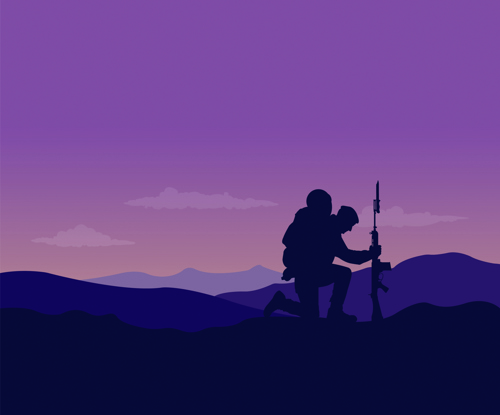
On 2nd April 1982, Argentine forces invaded the Falkland Islands. The 74-day conflict that followed involved more than 30,000 British personnel. The islands were liberated on 14th June, but 255 British personnel lost their lives.
The Falkland Islands are about 300 miles east of the Argentine coast and have been under British administration since 1833.
Argentina has long maintained that the islands rightfully belong to Argentina, based on geographical proximity and its claim that it inherited them from the Spanish Crown. Britain has maintained that it has sovereignty over the islands and that the islanders - the overwhelming majority of whom are of British descent - have the right to determine their own future.
In December 1981, a change of leadership brought General Leopoldo Galtieri to power. Argentina had been under military rule since 1976, a period that had seen widespread international condemnation for the so-called Dirty War: a systematic campaign of state terror in which an estimated 30,000 people were killed or disappeared.
With the economy struggling and public opposition to military rule growing, Galtieri calculated that seizing the Falklands would unite the Argentine public behind his government, and that Britain would not respond with military force.
On 2 April 1982, Argentine troops landed on the Falkland Islands and quickly overwhelmed the small garrison of 57 Royal Marines. The following day, Argentine forces seized the dependent territories of South Georgia and the South Sandwich Islands.
Britain's response was swift. Within hours, Prime Minister Margaret Thatcher's government had condemned the invasion, and plans were already underway to send a naval task force to retake the islands.
On 5 April, a task force of 127 ships, including aircraft carriers HMS Hermes and HMS Invincible, sailed from Portsmouth to begin the 8,000-mile journey to the South Atlantic.
On 25 April, British forces successfully recaptured South Georgia. Following the surrender of the Argentine garrison, Lieutenant Commander David Penfold sent this message to London:
"Be pleased to inform Her Majesty that the White Ensign flies alongside the Union Flag in South Georgia. God save the Queen."
Meanwhile, RAF Vulcan bombers carried out the Black Buck missions - some of the longest bombing sorties ever attempted - targeting the airfield at Port Stanley.
As the campaign intensified, both sides suffered significant losses.
On 2nd May, the British submarine HMS Conqueror torpedoed the Argentine cruiser General Belgrano, killing 323 Argentine sailors. The ship had been sailing outside the declared exclusion zone, and its sinking prompted considerable controversy about the rules of engagement. Two days later, HMS Sheffield was struck by an Exocet missile, becoming the first British warship lost in action since the Second World War. Twenty of her crew died.
On 12th May, the 5th Infantry Brigade, comprising the Scots Guards, Welsh Guards, Gurkhas and their supporting elements, sailed south aboard the requisitioned ocean liner Queen Elizabeth 2. Among those on board was Bill McDowall, a 21-year-old member of the 2nd Battalion Scots Guards.
Sailing separately was Norman McDade, who prefers to go by the name Mac, a Royal Navy chef from Scotland who had joined up aged 17 and was serving aboard HMS Plymouth.
When not dodging bombs and defending troops against fighter jets, the Navy chef-turned gunner was involved in assisting in the transportation of soldiers arriving from the UK onto ships going into battle.
This is where the two are believed to have come across each other for the first time.
“There is definitely a possibility we waved at each other or saw each other at this point,” Mac said.
“It’s not always easy to recognise everyone because we all look a little different now; most of us certainly have less hair.”
British troops began landing at San Carlos Water on 21st May. The sheltered bay offered the best opportunity to establish a bridgehead, but it also exposed ships to repeated attacks from Argentine aircraft.
Argentine pilots launched wave after wave of bombing raids against British ships in the days that followed. The attacks were so relentless that San Carlos Water became known as Bomb Alley. HMS Ardent, HMS Antelope and HMS Coventry were all sunk within four days, with 42 crew members lost.
On land, soldiers encountered rocky hills, deep peat bogs, and freezing temperatures, carrying packs that often weighed more than 80 pounds. The Battle of Goose Green on 28th–29th May saw 690 British paratroopers face 900 Argentine troops. Eighteen paratroopers were killed, among them their commanding officer, Colonel 'H' Jones, who was posthumously awarded the Victoria Cross.
Bill and the 2nd Battalion Scots Guards landed at Fitzroy on East Falkland on 6th June. The journey there had involved multiple ship-to-ship transfers in freezing conditions.
Speaking about his memory of the transfers between boats, he was “reduced to tears” on several occasions.
“In the boats, most of us were crouching, kneeling or sitting in icy water which had gathered at the bottom. At times it was so cold that I could barely hold my rifle. It was from HMS Intrepid that we were launched, crammed into a couple of landing crafts for what could only be described as a night of freezing cold and wet hell.
At one point during the night, shells burst over the landing crafts, shells which were fired from Royal Navy warships that were unaware that the battalion was in the landing craft and came very close to identifying us as the enemy and opening fire.”
On the night of 13th June, Bill and his regiment fought in the Battle of Mount Tumbledown, involving hand-to-hand fighting in darkness across steep, rocky ground. Nine Scots Guards were killed and 47 were wounded.
“I still find it difficult to talk about the moments that changed my life forever,” Mr McDowell said.
On 14th June 1982, with British troops surrounding Port Stanley and its key defensive positions lost, Argentine commander Major General Mario Menéndez surrendered to Major General Jeremy Moore. After 74 days of conflict, the Falkland Islands were once again under British control.
The Falklands War claimed the lives of 255 British service personnel, 649 Argentine military personnel, and three Falkland Islanders. Thousands more were wounded, both physically and psychologically.
Some faced life-changing injuries, while others struggled with the emotional impact of combat long after returning home. Support for PTSD and mental health conditions was far more limited than now, and many veterans suffered.
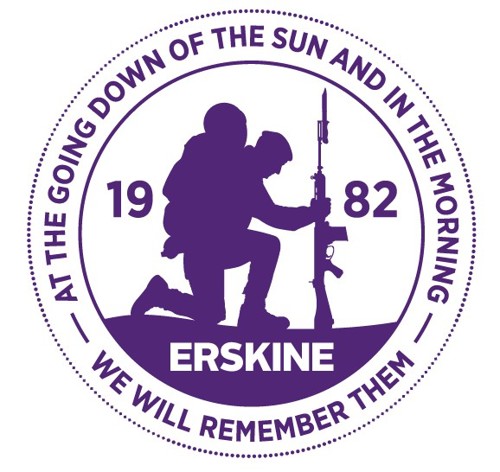
Bill and Mac both survived the conflict and, in the years that followed, both found their way to Erskine. In 2022, on the 40th anniversary of the Argentine invasion, the two men met for the first time since the conflict.
At the remembrance service, Erskine unveiled The Shadow of the Brave, a 5ft Corten steel sundial modelled on the silhouette of Bill kneeling and paying his respects to his fallen comrades. Bill, now 61, works and resides in the Erskine Veterans Village.
Since 1916, Erskine has provided care and support to over 105,000 Veterans across Scotland, including troops from the Falklands conflict.
If you or someone you know could benefit from Erskine's support, find out more here. To support our work, donate here.

We couldn't do what we do without the likes of you!


